Intrusion Detection Enters New Era: AI Agents Now Questioning Network 'Sense'
Breaking: Signature-Based Detection Faces Obsolescence as AI Agents Redefine Threat Response
Cybersecurity has reached a turning point. Traditional signature-based detection systems, which rely on matching known threat patterns, are being supplanted by machine learning and autonomous agents that ask a fundamentally different question: Does this traffic make sense in its current context?
Dr. Elena Marchetti, lead researcher at the CyberAI Institute, explains: "We've moved from pattern matching to contextual reasoning. An agentic AI doesn't just flag a known bad signature; it evaluates whether a network activity logically fits—or looks suspiciously out of place."
This shift, driven by platforms like SnortML, promises to catch novel attacks that no signature database has ever seen. The technology is already being deployed in pilot programs at several Fortune 500 firms, with early results showing a 40% reduction in false positives.
Background: The Limits of Pattern Matching
For decades, intrusion detection relied on static rules: if a packet matches a known malicious pattern, alert. But attackers quickly learned to morph signatures, using polymorphic code and encryption to evade detection.
Machine learning introduced a more flexible approach—training models on vast datasets to recognize anomalous behavior. Yet even ML models often lacked the ability to reason about the why behind an anomaly.
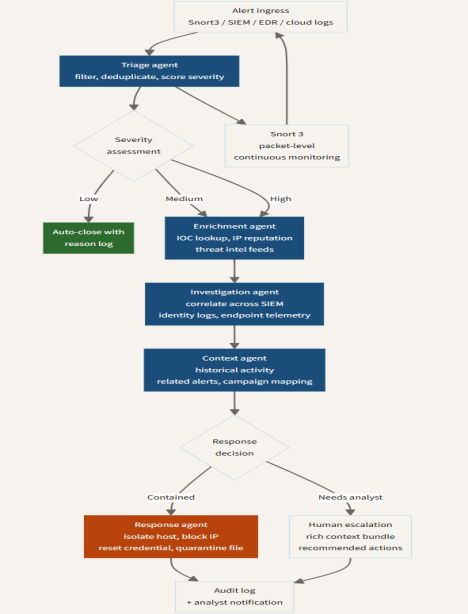
Enter agentic AI. These autonomous systems don't just classify; they act. They can quarantine a suspicious process, cross-reference with threat intelligence feeds, and even initiate countermeasures—all without human intervention.
What This Means for Enterprise Security
The implications are profound. Security teams that once spent hours triaging alerts can now trust AI agents to handle routine incidents autonomously. This frees up analysts for strategic threat hunting.
However, experts caution against over-reliance. "Agentic AI is not a silver bullet," warns Dr. Marcus Vega, a former NSA cybersecurity director. "If the training data is biased or the environment shifts, these agents can make catastrophic decisions."
Regulatory frameworks are also lagging. Governments are scrambling to draft rules for autonomous decision-making in security contexts, raising questions about liability and accountability.
The Technical Shift: From 'Does this match?' to 'Does this make sense?'
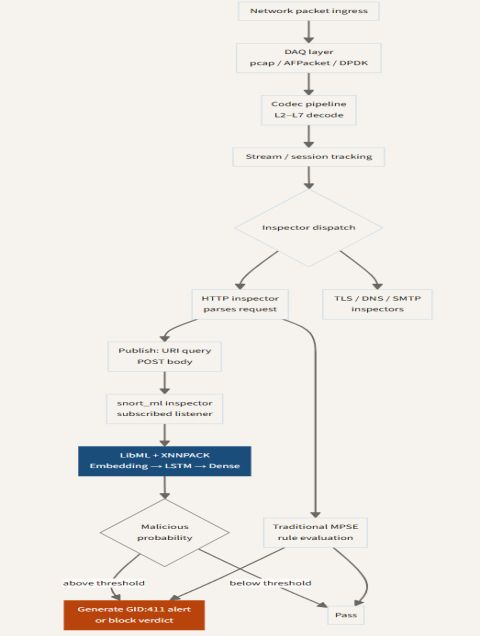
At the core of this evolution is a change in the fundamental question. Instead of scanning packets for a known bad hash, systems now ask whether a sequence of actions aligns with typical user behavior or network baselines.
SnortML, a key player in this space, integrates deep learning models directly into the packet inspection pipeline. Its agents can interpret encrypted traffic using metadata patterns, a feat that traditional sensors cannot match.
Expert Reactions and Next Steps
Industry bodies like the Cybersecurity and Infrastructure Security Agency have issued advisory notes urging organizations to pilot agentic AI cautiously. "We're in uncharted territory," says CISA's chief technologist, Dr. Jenna Lee. "The potential is huge, but so is the risk of unintended consequences."
Vendors are racing to market, with several startups announcing agentic-intrusion-detection products this month. Market analysts project the segment will grow at 35% CAGR through 2030.
For now, security professionals must adapt. Training teams to understand and oversee AI agents will become as important as mastering firewall rules. The era when a sensor could only 'think' in signatures is ending.
Related Articles
- Defending Against IoT Botnet Threats: A Comprehensive Guide Inspired by the Aisuru-Kimwolf Takedown
- Amazon FSx for NetApp ONTAP S3 Access Points Revolutionize Serverless Data Pipelines: No Data Migration Required
- Mastering the Anthbot M9: A Complete Guide to iPhone-Controlled Lawn Care
- Homebridge 2.0 Adds Matter Support: Expanding Apple Home Compatibility
- 7 Key Insights into NVIDIA and ServiceNow's Autonomous AI Agents for Enterprises
- Intrusion Detection Gets an AI Overhaul: Context Beats Signatures
- Amazon's 30-Minute Delivery Service Expands to Select US Cities
- 10 Essential Insights for Validating Non-Deterministic Agent Behavior in CI/CD