From Sea to Solid Ground: 6 Key Reasons V8 Replaced Its Oceanic Compiler
For over a decade, V8’s TurboFan compiler navigated the innovative but turbulent Sea of Nodes (SoN) intermediate representation. However, beginning around 2021, the team started charting a course back to the stable shores of a traditional Control-Flow Graph (CFG) IR, named Turboshaft. Today, Turboshaft powers the entire JavaScript backend and the whole WebAssembly pipeline, with only a few remnants of SoN remaining. What drove this massive shift? Here are six critical factors that convinced V8 engineers to abandon the oceanic metaphor for solid ground.
- Crankshaft’s Technical Debt Became Unsustainable
- Hand-Written Assembly for Every Architecture Slowed Progress
- No Control Flow During Lowering Limited Optimizations
- Try-Catch Support Was Nearly Impossible
- Performance Cliffs and Bailouts Frustrated Developers
- Deoptimization Loops Wasted Optimization Efforts
1. Crankshaft’s Technical Debt Became Unsustainable
Back in 2013, V8 relied solely on Crankshaft, its first optimizing compiler. While Crankshaft delivered impressive speedups, it accumulated significant technical debt over its lifetime. The team constantly added features and workarounds, resulting in a codebase that became increasingly fragile and difficult to maintain. New engineers struggled to understand the tangled logic, and every change risked breaking something else. The debt was so deep that even simple improvements required disproportionate effort, draining resources that could have been spent on innovation. Turboshaft, built from a clean slate, allowed the team to adopt modern design principles and reduce ongoing maintenance costs.
2. Hand-Written Assembly for Every Architecture Slowed Progress
When Crankshaft introduced a new IR operator, developers had to manually write its translation to assembly for each of the four supported architectures: x64, ia32, arm, and arm64. This tedious process consumed weeks of work and was prone to human error. Moreover, porting to new architectures (like MIPS or RISC-V) meant repeating the same effort. The Sea of Nodes inherited this problem from Crankshaft, making it costly to add any lowering or optimization that introduced new IR nodes. Turboshaft, on the other hand, uses a more abstract machine description, drastically reducing the amount of hand-written assembly and enabling faster iteration on new features.
3. No Control Flow During Lowering Limited Optimizations
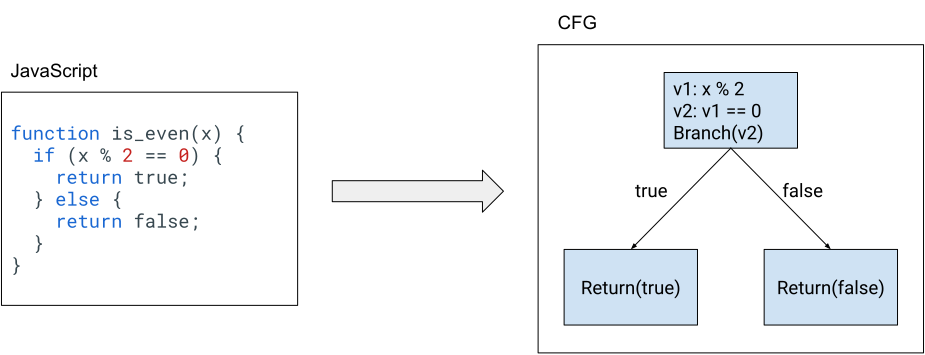
In Crankshaft, control flow was fixed at graph building time. Once the initial graph was created, adding or modifying branches, loops, or other control structures during later phases was impossible. This severely restricted common compiler techniques, such as lowering a high-level JSAdd(x, y) into a conditional that checks whether operands are strings or numbers. Without the ability to introduce new control flow, optimizers either had to bake complex logic into the initial graph or bail out entirely. The Sea of Nodes attempted to solve this by allowing flexible node reordering, but it still lacked an easy way to add control flow after the fact. Turboshaft embraces a CFG from the start, making such lowerings straightforward and efficient.
4. Try-Catch Support Was Nearly Impossible
Try-catch blocks are crucial for robust JavaScript applications, but Crankshaft never supported them. Over the years, multiple engineers spent months—sometimes years—trying to add try-catch to the Sea of Nodes environment, but every attempt failed. The fundamental challenge lay in the graph representation: exception handling requires precise control flow and deoptimization semantics that the SoN model could not express cleanly. Without try-catch, functions using exception handling were left unoptimized, harming performance for a common pattern. Turboshaft’s CFG-based IR naturally accommodates try-catch, enabling optimized execution of error-handling code for the first time.
5. Performance Cliffs and Bailouts Frustrated Developers
JavaScript developers often encountered sudden, dramatic performance drops—sometimes by a factor of 100—when using certain features or hitting specific edge cases. These performance cliffs occurred because the compiler would resort to slow fallback paths or bail out to unoptimized code. The Sea of Nodes’ complexity made it hard to predict which combinations of operations would trigger these cliffs. This unpredictability forced developers to write awkward code and constantly profile their applications. Turboshaft’s cleaner design allows more consistent optimization, reducing the frequency and severity of cliffs. By moving to a CFG, the team can better reason about the compiler’s behavior and provide reliable performance.
6. Deoptimization Loops Wasted Optimization Efforts
One of the most frustrating issues in Crankshaft was the deoptimization loop. The compiler would optimize a function based on speculative assumptions (e.g., “this argument is always an integer”). If those assumptions failed, the code deoptimized back to the interpreter. But then, the system would often reoptimize the same function with the same flawed assumptions, leading to a cycle of compilation and deoptimization. This wasted CPU cycles and memory while delivering poor performance. The Sea of Nodes inherited this problem because its speculative optimization framework lacked proper feedback mechanisms. Turboshaft incorporates a more robust profiling and feedback loop, breaking these cycles and ensuring that optimizations remain stable over time.
Conclusion
The shift from the Sea of Nodes to Turboshaft wasn’t a whim—it was a calculated response to deep-rooted engineering challenges. By shedding the complex SoN representation in favor of a proven CFG model, V8’s team eliminated years of technical debt, simplified architecture support, enabled powerful lowerings, brought try-catch support, reduced performance cliffs, and stopped deoptimization loops. Today, Turboshaft powers not only the JavaScript backend but also WebAssembly, with only the builtin pipeline and JavaScript frontend still using remnants of the old Sea of Nodes. The voyage back to solid ground has made V8 faster, more predictable, and easier to maintain for years to come.
Related Articles
- Lexus Set to Debut Its First Three-Row Electric SUV: A Luxury Counterpart to Toyota's Highlander EV
- HBO's Lanterns Unveils First Look at Green Lantern Energies in Upcoming Trailer
- Ride1Up Upgrades Its Popular Roadster V3 With Front Suspension: What You Need to Know
- Chery's Multi-Brand Strategy: A Pathway to Success in the Canadian Auto Market?
- How to Automate Large-Scale Dataset Migrations Using Background Coding Agents and Fleet Management
- College Laptop Guide: Your Top Questions Answered (Including Our #1 Pick)
- Exclusive Deal: Yozma IN 10 Electric Mini Dirt Bike Hits Record Low $999; EcoFlow and Anker Deals Follow
- WebAssembly JSPI Gets a Simplified API in Chrome M126: What’s New and How to Use It