SpaceX’s 34th Resupply Mission Delivers Cutting-Edge Science to the International Space Station
Introduction
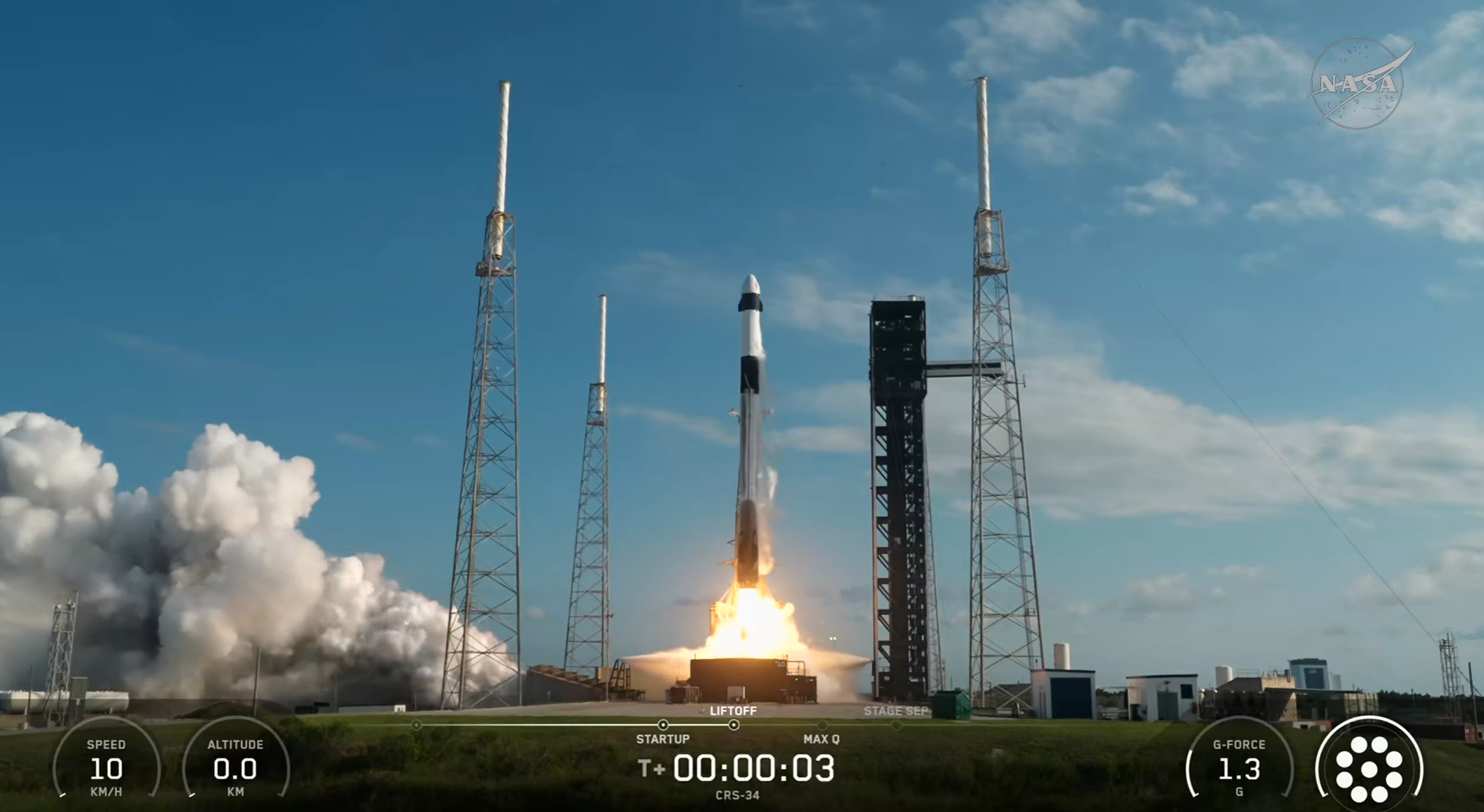
On May 15, 2026, the latest chapter in the partnership between NASA and SpaceX unfolded as a Falcon 9 rocket lifted off from Florida, carrying the Dragon cargo spacecraft toward the International Space Station. This 34th commercial resupply mission under NASA’s auspices brings nearly 6,500 pounds of supplies, equipment, and groundbreaking scientific investigations to the orbital outpost and its Expedition 74 crew.
A Smooth Liftoff and Autonomous Docking
The Falcon 9 rocket launched from Space Launch Complex 40 at Cape Canaveral Space Force Station at 6:05 p.m. EDT. After a successful ascent, the Dragon spacecraft separated and began its journey to the station. Dragon is scheduled to autonomously dock with the forward port of the Harmony module at approximately 7 a.m. on Sunday, May 17. Viewers can follow the rendezvous and docking live starting at 5:30 a.m. on NASA+, Amazon Prime, and NASA’s YouTube channel. The agency also offers multiple ways to watch via social media and other online platforms.
A Wealth of Cargo and Scientific Experiments
Beyond the essentials for the crew, this mission is notable for the suite of new experiments and instruments it carries. Each investigation aims to expand our understanding of biology, physics, and the space environment.
Simulating Microgravity on Earth
One experiment will test how well Earth-based simulators can mimic the microgravity conditions of space. This could improve the accuracy of ground-based experiments and reduce the need for costly spaceflight tests in some research areas.
Wood-Based Bone Scaffolds for Osteoporosis
A particularly innovative experiment involves a bone scaffold made from wood. Researchers hope that studying how this scaffold behaves in microgravity could lead to new treatments for bone diseases such as osteoporosis, which causes bones to become fragile and brittle.
Red Blood Cells and Spleen Changes in Space
Equipment delivered on this mission will help scientists evaluate how red blood cells and the spleen are affected by long-duration spaceflight. Understanding these changes is critical for astronaut health on future missions to the Moon and Mars.
Monitoring Charged Particles Around Earth
A new instrument will study charged particles in Earth’s magnetosphere. These particles can disrupt power grids and damage satellites, so better knowledge will help protect critical infrastructure both in orbit and on the ground.
Probing Planet Formation
An investigation aimed at the fundamental physics of how planets form will also be conducted. The results could reshape our models of solar system evolution and the conditions that lead to habitable worlds.
Precise Measurements of Sunlight Reflection
Another instrument is designed to take highly accurate measurements of sunlight reflected by Earth and the Moon. Such data are valuable for climate science and for calibrating Earth-observing satellites.
The Broader Mission of the Space Station
These experiments join the hundreds of investigations already conducted aboard the station in fields ranging from biology and biotechnology to physical sciences and Earth science. For over 25 years, the International Space Station has hosted a continuous human presence, enabling research that cannot be performed on Earth. It serves as a testbed for technologies needed for long-duration spaceflight, including those that will support NASA’s Artemis program to return humans to the Moon and future missions to Mars. The station also fosters commercial opportunities in low Earth orbit, creating a robust space economy.
Looking Ahead: Dragon’s Stay and Return
The Dragon spacecraft is scheduled to remain docked at the station until mid-June. After that, it will depart, carrying time-sensitive research samples and cargo back to Earth. The spacecraft is designed to splash down off the coast of California, where teams will recover the valuable payload for analysis.
For full details on International Space Station research, operations, and crew activities, visit NASA’s space station page.
Related Articles
- How Enterprises Can Enter the Compute Capacity Market: A Step-by-Step Guide
- Understanding and Tracking Earth's Ring Current: A Guide to the STORIE Mission
- How Microsoft Discovery Is Transforming R&D with Agentic AI
- May 2026 Ames Science Stars: Honoring Excellence at NASA Ames
- How NASA Plans to Test Lunar Landers in Earth Orbit: The Artemis III Blueprint
- Pinpointing the Culprit: Automated Failure Attribution in LLM Multi-Agent Systems
- Unlocking Astrocyte Potential: How Sox9 Protein Could Combat Alzheimer’s
- Gentlemen RaaS Admins Confirm Internal Database Breach — Affiliate Operations Exposed