Breaking the Fork: Meta's Strategy for Keeping WebRTC Up-to-Date
Meta relies on WebRTC for real-time audio and video across Messenger, Instagram, Cloud Gaming, and VR casting on Quest. For years, they maintained a customized fork of the open-source library, but that fork risked falling behind upstream updates—a common pitfall known as the “forking trap.” To escape it, Meta built a dual-stack architecture that allowed them to A/B test two versions of WebRTC simultaneously within the same app, migrating over 50 use cases to the latest upstream version without breaking user experiences. Below, we answer key questions about how they accomplished this.
What Is the “Forking Trap” in Open-Source Projects?
The forking trap occurs when an organization forks a large open-source project like WebRTC to add custom features or quick fixes. Initially, the fork works well. But over time, the upstream project evolves with community improvements, security patches, and performance enhancements. Meanwhile, the internal fork accumulates proprietary changes, making it increasingly difficult and expensive to merge in upstream commits. Eventually, the fork diverges so far that upgrading feels impossible—cutting the team off from vital updates and locking them into an outdated, hard-to-maintain codebase. Meta faced this exact scenario with their WebRTC fork, which served billions of users but risked stagnation.
What Challenges Did Meta Face with a Monorepo and Static Linking?
Meta operates a massive monorepo containing all their application code. Upgrading a library like WebRTC in this environment is risky: a single bad release could break experiences across Messenger, Instagram, Cloud Gaming, and VR—affecting billions of users. Rolling back is not straightforward. To mitigate this, Meta required the ability to A/B test—running both the legacy WebRTC fork and the new upstream version side-by-side in the same app. However, statically linking two versions of the same C++ library violates the One Definition Rule (ODR), causing thousands of symbol collisions. So they needed a way to make both versions coexist in the same address space without conflicts, all while keeping the binary size under control.
What Is the Dual-Stack Architecture Meta Built?
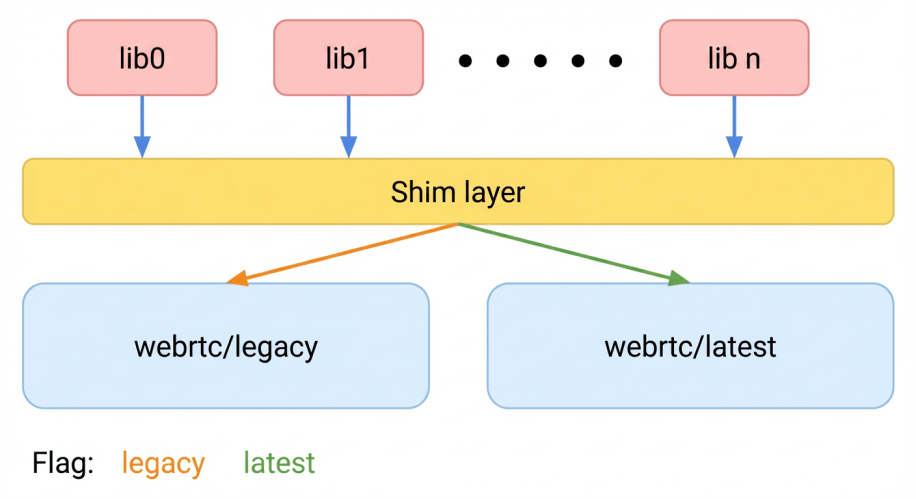
Meta engineered a dual-stack architecture that allows two complete WebRTC libraries—the old divergent fork and the new upstream-based version—to live in the same binary. They achieved this by namespacing each version: all symbols (classes, functions, globals) of one stack were wrapped in a unique C++ namespace, preventing ODR violations. This enabled them to build both WebRTC stacks separately and then link them together. The same application can dynamically switch a user between the two stacks for A/B testing, using feature flags or experiment frameworks. This approach also allowed incremental migration: each use case (e.g., Messenger voice call, Cloud Gaming stream) could be tested individually without disrupting others. A/B testing became safe and scalable.
How Did Meta A/B Test Two WebRTC Versions in Production?
With the dual-stack architecture in place, Meta integrated their experimentation platform to randomly assign users to either the legacy WebRTC stack or the new upstream stack for any given RTC use case. For example, a small percentage of Messenger video calls used the new stack, while the rest used the old one. Key metrics like call setup time, audio/video quality, CPU usage, and crash rates were compared. This allowed them to detect regressions early and roll back quickly if needed. They could also run canary tests on internal devices first. Over time, they iteratively enabled the new stack for more users, use case by use case, until all 50+ use cases had migrated—without ever pushing a global, risky upgrade. Continuous A/B testing remains their standard for each new upstream WebRTC release.
How Did Meta Overcome the C++ One Definition Rule (ODR)?
The C++ One Definition Rule states that every non-inline function or variable must have exactly one definition across the entire program. Statically linking two libraries that define the same symbols (e.g., webrtc::PeerConnectionFactory) causes linker errors or undefined behavior. Meta solved this by wrapping the entire upstream WebRTC codebase in a custom namespace, e.g., meta_webrtc_upstream, while the legacy fork retained the original webrtc namespace. All internal references within each stack were adjusted to use their respective namespaces. This way, both libraries compiled cleanly and linked together without collisions. At the application layer, a thin abstraction layer decided which namespace’s objects to instantiate based on the A/B test assignment. This technique is portable and doesn’t require modifying upstream source files per se—just build system adaptations.
How Does Meta Now Stay Continuously Upgraded with Upstream WebRTC?
Once the migration to the upstream-based stack was complete, Meta established a CI/CD pipeline that automatically downloads each new upstream WebRTC release (e.g., from the official Chromium repository), applies Meta’s proprietary patches for features like echo cancellation or video codecs, and builds a new candidate stack. This candidate is then A/B tested against the current production stack using the dual-stack architecture. If the new release passes quality gates (no regressions in key metrics), it is promoted to production gradually. If issues arise, the rollout is halted and fixes are sent back upstream or applied locally. This continuous cycle—often every few weeks—ensures Meta benefits from community improvements, security fixes, and performance gains without ever falling into the forking trap again.
What Were the Outcomes of This Migration?
By escaping the forking trap, Meta achieved several concrete improvements. Performance: the new upstream-based stack leveraged latest optimizations from Chromium, reducing CPU usage and latency for many use cases. Binary size: the old fork had many unused code paths; the new architecture allowed stripping unnecessary components, shrinking the library’s footprint. Security: regular upstream merges brought critical vulnerability patches that the old fork had missed. Most importantly, the dual-stack A/B testing workflow became a permanent part of Meta’s RTC engineering process. Today, every upstream release is evaluated in production before wide rollout, ensuring stability for billions of users. This methodology can be applied to any large C/C++ open-source library that an organization has forked, offering a path to escape the forking trap permanently.
Related Articles
- Breathe New Life Into Your Old PC: Windows 11 Pro for Under $10 – Your Questions Answered
- Understanding Diffusion Models for Video Generation: Key Challenges and Insights
- Age Assurance Laws: What Developers Need to Know
- GitHub Deploys AI System to End Accessibility Feedback Black Hole: Every Report Now Tracked to Resolution
- GitHub's New Open Source Guide Empowers Beginner Developers to Make First Contributions
- States Rush to Seal License Plate Surveillance Data as Public Records Expose Abuses
- k6 2.0 Launches with AI-Powered Testing and Browser Automation Upgrades
- Transitioning an Open Source License: Lessons from the PHP Project's Move to BSD